

Image credit: Michelle Reback, Wikimedia Commons, CC BY-SA 4.0. Licensed under CC BY-SA 4.0.
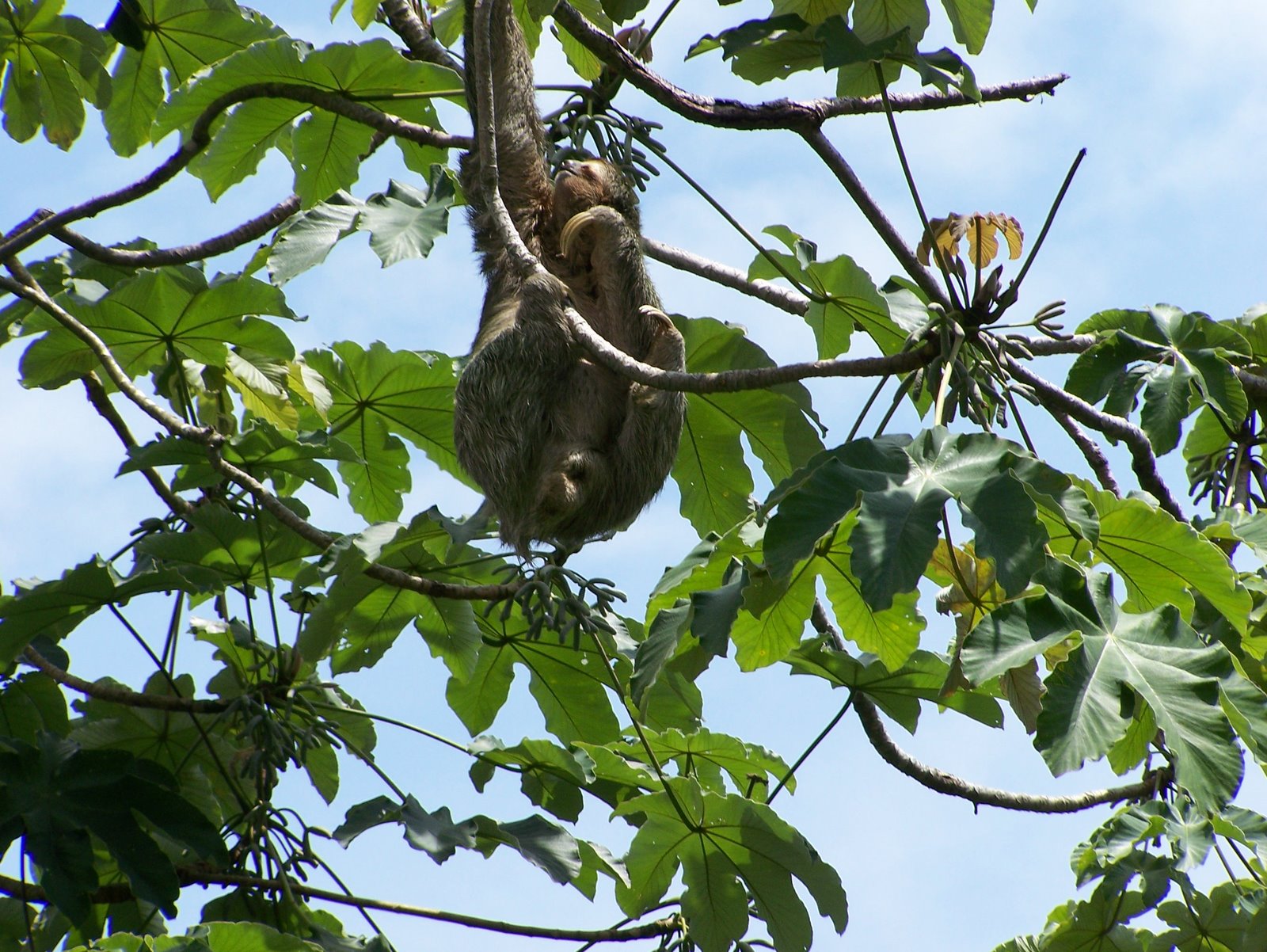
Sloths make much more sense when you stop thinking of them as slow animals on the ground and start seeing them as rainforest canopy specialists. Their world is not roads, paths, pavements, or even the forest floor. It is branches, leaves, shade, rain, and quiet movement high above the ground.
That tree-first lifestyle explains almost everything people find strange about sloths: their slow pace, their long curved claws, their leafy diet, their upside-down resting, and even the greenish tint that can appear in their fur. Sloths are not badly designed for speed. They are beautifully adapted for a life where saving energy and staying hidden matter more than rushing anywhere.
The canopy is home, not a hiding place
WWF describes sloths as tree-dwellers of Central and South American tropical rainforests, moving through the canopy while feeding on leaves, twigs, and buds. The Smithsonian National Zoo notes that two-toed sloths spend most of their time high in tropical rainforest canopies, where their limbs and claws help them hang, climb, rest, eat, and travel from branch to branch.
For a sloth, being in the trees is not just a way to avoid danger. It is the centre of daily life. Food is there. Shelter is there. Mates are found there. Babies are born there. A healthy, connected canopy lets sloths move without needing to spend much time on the ground, where they are far more vulnerable.
Slow movement is an energy strategy
Sloths are famous for being slow, but the important question is why. The answer starts with energy. Leaves are not a rich, sugary food. They are tough, fibrous, and often low in calories compared with fruit or meat. A leaf-heavy diet works best when the animal using it is very efficient.
WWF notes that sloths have an exceptionally low metabolic rate. The Smithsonian also explains that two-toed sloths use energy frugally and move slowly over small home ranges. That slow movement is not laziness. It is a sensible way to live on a diet that takes time to process and does not deliver quick bursts of energy.
This is one of the loveliest things about sloths. They are not trying to win a race. They are playing a different game entirely: use little, waste little, stay calm, and keep going.
Their diet is built around leaves, shoots, and patience
Sloth diets vary by species, but leaves are a major part of the story. The Smithsonian says two-toed sloths eat leaves, fruit, and selected fresh green shoots, while WWF describes sloths munching on leaves, twigs, and buds as they travel through the canopy.
The Sloth Conservation Foundation’s Slothopedia also highlights how specialised sloth biology is. Sloths have evolved around conserving energy, moving deliberately, and surviving in rainforest habitats where their food is spread through the trees.
That diet also helps explain why sloths do not need to roam huge distances each day. If your food grows all around you, and your body is designed to run on a low-energy budget, the smartest move is often not to move very far at all.
Camouflage is part of the plan
Speed is one way to avoid predators. Sloths use a quieter method: blend in and avoid attention. The Smithsonian describes sloths as a “walking ecosystem”, with coarse hair that can take on a greenish tint in moist conditions because of algae growth. That green shade can help them disappear into the leafy canopy.
Sloth fur can also host other tiny life, including moths and beetles. It sounds odd at first, but it fits the bigger picture. Sloths are deeply tied to the rainforest around them, not separate from it. Their bodies, habits, and habitats all work together in a slow, subtle system.
Why the forest floor is risky
Sloths do come down from the trees, but the ground is not their comfort zone. WWF points out that when sloths descend to the forest floor, they are more exposed to predators and have little ability to defend themselves compared with many faster mammals.
This is one reason connected rainforest matters so much. If trees are cleared or fragmented, sloths may be forced to travel across gaps, roads, fences, or open ground. That turns a normal journey into a dangerous one. Conservation is not only about saving individual trees. It is about keeping canopy routes connected enough for wildlife to live naturally.
Sloths are slow, but their habitat problems are urgent
The health of sloth populations depends heavily on the health of tropical rainforests. WWF highlights deforestation as a major threat because sloths rely on trees for shelter and food. When rainforest is broken up, sloths lose the continuous canopy that makes their lifestyle possible.
That is why groups working on rainforest protection, habitat restoration, wildlife crossings, and community-led conservation matter. A sloth does not need a motorway. It needs trees, safe routes, and a forest that still functions as a forest.
What sloths can teach us
It is easy to turn sloths into a joke about laziness, but that misses the point. Sloths are specialists. They have spent millions of years becoming very good at one kind of life: slow, careful, tree-based survival in tropical forests.
That makes them a brilliant reminder that “successful” does not always mean fast, loud, or constantly busy. Sometimes it means being perfectly suited to your environment, conserving energy, and moving only as much as you need to.
And honestly, that is a pretty good lesson from an animal hanging quietly in the leaves.