

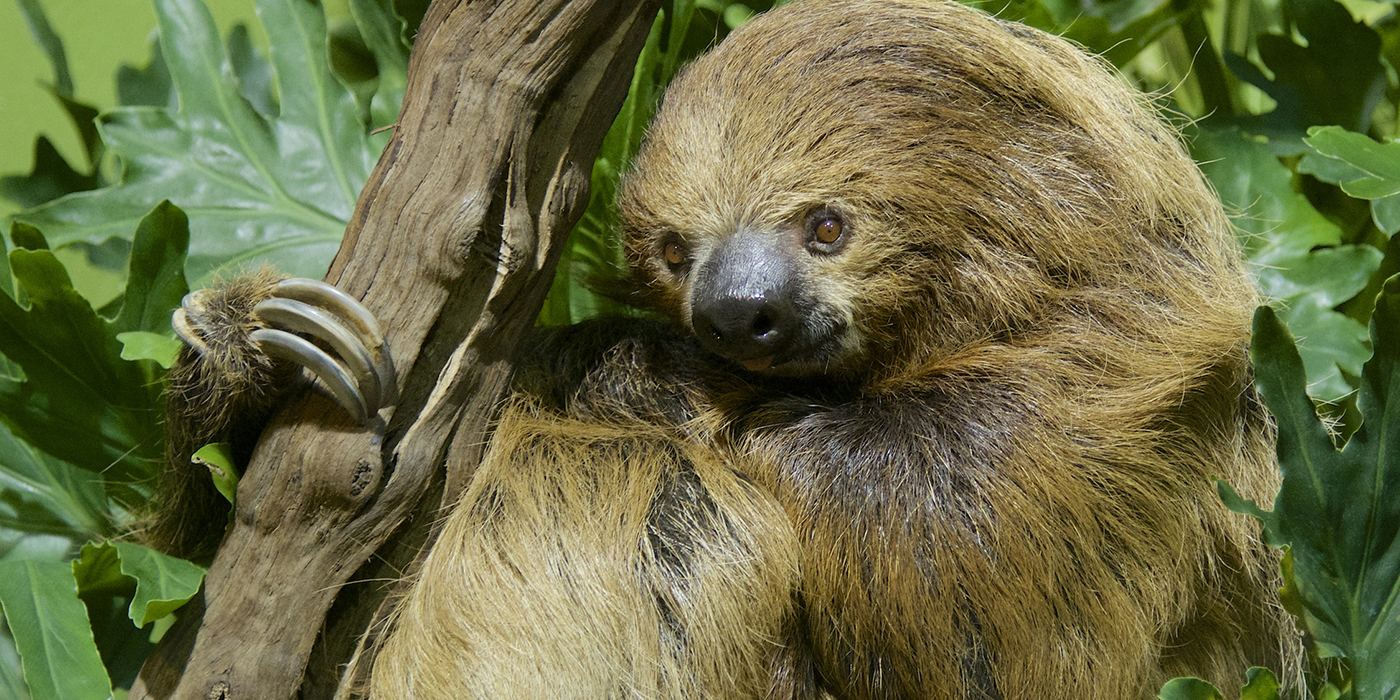
Image: Smithsonian National Zoo and Conservation Biology Institute.
Sloths are easy to love because they look gentle, sleepy and wonderfully unbothered. But they are not just cute rainforest characters. They are highly specialised canopy animals, shaped by a slow diet, careful movement, strong climbing bodies and a life spent mostly among leaves. When we understand sloths properly, we also understand why healthy tropical forests need connected trees, safe habitat and patient conservation work.
This is the bit that often gets missed: a sloth is not lazy. A sloth is economical. Everything about its body and behaviour is built around saving energy in a forest where leaves are plentiful, but not always easy to digest. That quiet strategy works beautifully when the canopy is whole. It becomes much harder when roads, power lines, gardens and cleared land split the forest into pieces.
Sloths are built for life in the canopy
The Smithsonian National Zoo describes two-toed sloths as tree-dwelling mammals with long limbs and curved claws that help them hang, climb and feed in the forest canopy. Their world is vertical. Instead of racing across the ground, they move through branches, vines and leaves, where their slow pace is part of the survival plan.
Britannica explains that sloths are arboreal mammals of Central and South America. That matters because trees are not just somewhere sloths rest. The canopy is their dining room, shelter, nursery and travel route. A connected canopy lets a sloth move without making dangerous trips across open ground.
Slow movement is a smart energy strategy
Sloths eat a leafy diet that takes time to process. Leaves can be tough, fibrous and relatively low in quick energy, so sloths have adapted by keeping their energy use low. Their slow movement is not a flaw. It is the tradeoff that lets them live on food many faster animals could not rely on in the same way.
The Rainforest Alliance explains that sloths have a low metabolic rate and spend a lot of time resting. That slow rhythm helps them conserve energy. It also helps them avoid attention. In the dappled green light of the rainforest, a still animal can be surprisingly hard to spot.
Sloth fur can become a tiny living habitat
One of the most fascinating things about sloths is that their fur can support algae and small invertebrates. The Sloth Conservation Foundation's Slothopedia introduces the unusual biology of sloths, including the ways their bodies are adapted for a slow arboreal life. In some species, grooved hair and damp rainforest conditions can help algae grow, adding a greenish tint that may make the animal blend more easily into the canopy.
That does not mean every sloth is a walking garden in the same dramatic way, and it is worth avoiding the myth that this is a simple cartoon superpower. The real story is better: sloths are part of a small, specialised web of life. Even their fur can become a place where other organisms live, which is exactly the sort of detail that makes rainforest ecosystems so extraordinary.
Connected forests make sloth life safer
A sloth's body makes sense in the trees. It makes much less sense on the ground. When the canopy is broken, sloths may have to descend and cross exposed spaces. That can bring them close to dogs, roads, people and power lines. For an animal designed to move slowly and carefully, those gaps are a serious problem.
This is why habitat connectivity is not an abstract conservation phrase. For sloths, it can mean the difference between travelling through branches and being forced into danger. Protecting mature trees, restoring corridors and making human spaces safer around rainforest edges are practical ways to support wildlife without turning conservation into something distant or impossible.
Why sloths are a good symbol for rainforest care
Sloths work well as rainforest ambassadors because they encourage people to slow down and look properly. A sloth story can lead to bigger questions: Where does this animal live? What happens when trees are removed? How do roads change animal movement? Why does rescue work take time? What does a healthy canopy actually provide?
Those questions matter more than a quick cute video. Sloths remind us that rainforest conservation is not only about saving individual animals, although that matters too. It is about protecting the living structure around them: the trees, food plants, safe routes, quiet resting places and connected habitat that let a slow animal thrive.
A small takeaway for sloth lovers
If you love sloths, the most useful thing to remember is that their slow life is not separate from the forest. It depends on the forest. A healthy canopy gives sloths room to feed, rest, hide and raise young. A broken canopy turns everyday movement into a risk.
So yes, sloths are adorable. They are also beautifully adapted rainforest specialists. The more we understand their quiet way of living, the easier it is to see why protecting their habitat is not optional. It is the whole story.
Sources and further reading
- Britannica: Sloth
- Rainforest Alliance: Sloth species profile
- Smithsonian National Zoo: Two-toed sloth
- The Sloth Conservation Foundation: Slothopedia
Image credit: Image: Smithsonian National Zoo and Conservation Biology Institute.