

Summary: Two-toed and three-toed sloths are both slow, leafy rainforest specialists, but their claws, habits and family trees are more different than their names suggest.
At first glance, a sloth is a sloth. It hangs from branches, moves with extraordinary patience, eats leaves and looks permanently unbothered by the rush of the world. Look a little closer, though, and the two main groups of living sloths are not just slightly different versions of the same animal.
Two-toed and three-toed sloths belong to different families. They share the same slow rainforest lifestyle, but they do not share every trick. Their claws, teeth, activity patterns, diet choices and even their usual facial expressions can tell you which kind of sloth you are looking at.
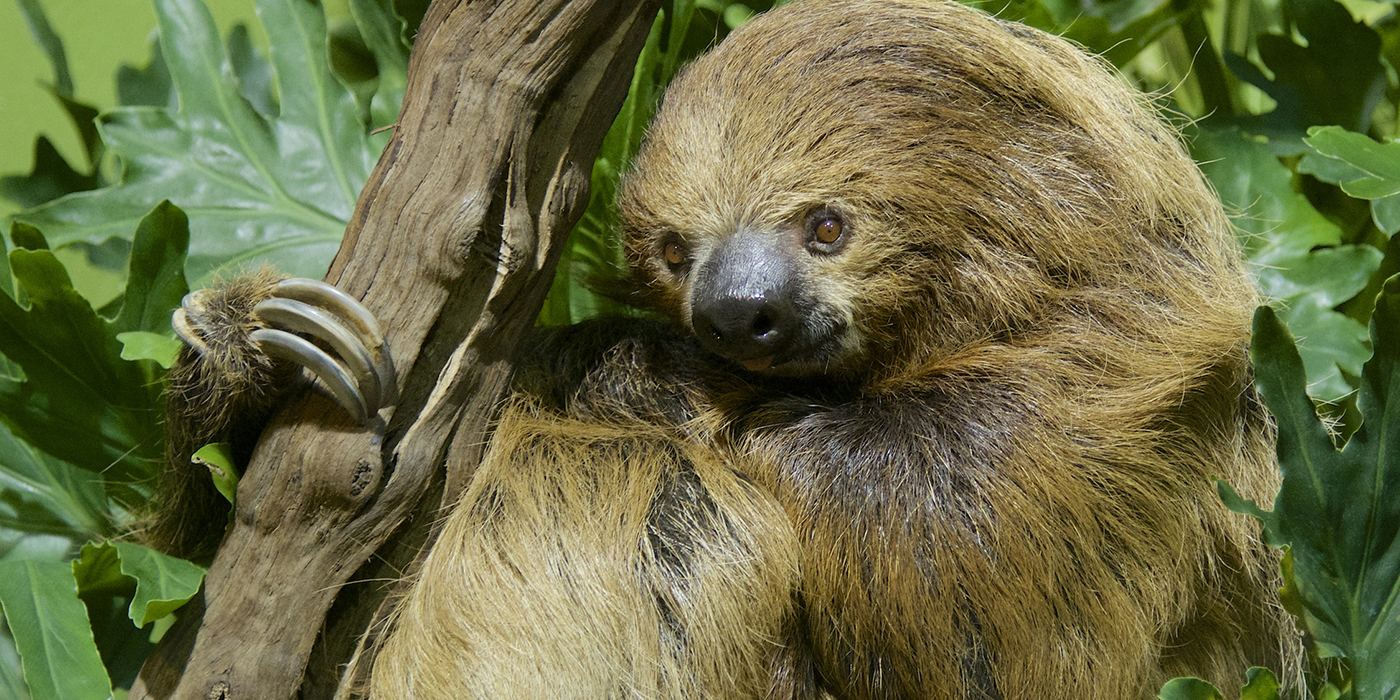
Image: Smithsonian National Zoo and Conservation Biology Institute.
The names are useful, but a bit sneaky
The simplest difference is right there in the name, but only if you are looking at the front feet. Two-toed sloths have two long claws on each forelimb. Three-toed sloths have three. The twist is that both groups have three claws on their back feet, so the name is not a full-body count.
Those long, curved claws are not just for show. They work like hooks, helping sloths suspend themselves below branches with far less effort than a human would need. The Sloth Conservation Foundation's Slothopedia explains how sloths are built around saving energy in the canopy, and their hanging lifestyle is one of the clearest examples.
They come from different sloth families
Two-toed sloths are in the genus Choloepus, while three-toed sloths are in the genus Bradypus. That matters because it means the difference is deeper than the number of claws. They are separate branches of the modern sloth family tree, both shaped by similar rainforest pressures.
The Smithsonian National Zoo notes that its two-toed sloth information covers a species with a slow metabolism, a leafy diet and a life spent largely in the trees. The University of Michigan's Animal Diversity Web gives separate profiles for Hoffmann's two-toed sloth and the brown-throated three-toed sloth, which is a handy reminder that these animals are not interchangeable.
Two-toed sloths are often bigger and more flexible eaters
Two-toed sloths tend to be larger and a little more robust-looking than three-toed sloths. They are still famously slow, of course, but they are generally considered more flexible in what they eat. Leaves are still central, yet two-toed sloths may also eat fruit, flowers and tender shoots when available.
That flexibility can matter in a changing habitat. A sloth does not have the option of simply sprinting off to find dinner somewhere else. Its best strategy is usually to know a small home range well, move carefully through connected trees and make the most of the food available there.
Three-toed sloths are the classic smiling sloths
When people picture a sloth with a little mask-like face and a gentle, almost smiling expression, they are often imagining a three-toed sloth. Brown-throated three-toed sloths are among the most familiar species in photos, documentaries and educational material.
Three-toed sloths are often more specialised leaf eaters. Their slow digestion and low-energy lifestyle make sense when you remember that leaves are not an easy food. They can be tough, fibrous and relatively low in calories. A three-toed sloth's whole routine is built around making that diet work without wasting energy.
Their daily rhythms can differ too
Sloths are not simply lazy animals sleeping through life. They are energy managers. Two-toed sloths are often described as more nocturnal, while three-toed sloths can be active in both day and night patterns depending on species, weather, food and disturbance. In the wild, behaviour is usually messier than a neat label.
What both groups share is a careful pace. Slow movement helps conserve energy and can also make sloths harder for predators to spot among leaves and shadows. Their fur, posture and patience all help them blend into the canopy rather than outrun danger.
Both types still face the same big problem: broken habitat
It is fun to compare claws and faces, but the serious point is that both two-toed and three-toed sloths depend on healthy, connected rainforest. Roads, power lines, forest clearance, dog attacks and unsafe ground crossings can all turn a normal journey between trees into a dangerous one.
A sloth is safest when the canopy works like a living bridge. Connected trees let it feed, rest, find mates and move through its home range without being forced down to the ground too often. That is why habitat protection, reforestation and wildlife-friendly garden projects matter so much for sloths.
How to tell them apart quickly
- Front claws: two-toed sloths have two claws on the front feet, three-toed sloths have three.
- Face: three-toed sloths often have the more recognisable mask-like face.
- Build: two-toed sloths are usually larger and sturdier.
- Diet: both eat leaves, but two-toed sloths are often a little more varied in their diet.
- Family: they belong to different genera, Choloepus and Bradypus.
A small difference, then a bigger lesson
The claw count is the easy bit. The better lesson is that sloths are not simple, silly animals. They are specialised rainforest mammals with bodies built for a very specific way of life. Two-toed and three-toed sloths have each found their own version of the slow-living strategy, and both versions depend on forests that stay connected enough for them to survive.
So the next time someone asks the difference between the two, start with the claws. Then tell them the more interesting part: every sloth is a tiny masterclass in doing just enough, wasting almost nothing and trusting the trees.